Showing posts with label Sin. Show all posts

Saturday, July 20, 2024

Psalm 53 Hearing the Word

Photo: Greg K. Dueker

This psalm is nearly identical to Psalm 14 which I covered a decade ago in a well-read post entitled, Wise Up! However, Psalm 53 has a different target audience. This version may be speaking the words of Psalm 14 to the nations outside Israel rather than the unbelievers within the nation. 

It has often been said that this is the verse to read on April 1 (since in the US, it is known as April Fool’s Day). However, it is too easy to relegate the message of this short psalm to “those other people”, the professed atheists, those who vehemently deny the existence and goodness of God. However, verse 5 suggests that while this psalm originally addressed those who were the enemies of God’s people, and promised not only that they would be utterly destroyed but that history would hold no honor for them as well (God will scatter their bones), the flavor of the psalm as a whole shows the pervasive corruption of humanity (v. 2-3). It should also be said that a "fool" in the biblical sense is not someone who is unintelligent but someone who rejects God and trusts in his own riches (see how this psalm follows 51 and 52).

This reminds me that both insiders and outsiders are in desperate need of God’s mercy and his grace.

In this reflection, I would like to bring verse 1 a little closer to each of us.

The fool says in his heart, “There is no God.”
    They are corrupt, doing abominable iniquity;
    there is none who does good.

Author Unknown
Now as believers in the triune God through faith in the completed work of Jesus Christ, we would never say that there is no God. Or would we? I find that whenever it is easy to point the finger at others I am in a dangerous position. When we read a Bible passage or hear a sermon preached, and our first thought is about how another person needs to hear and heed that message, then we have become self-deceived. Instead, in the spirit of ophthalmic log removal (Matt. 7:3-5; Luke 6:41-42), we should internalize the application before projecting it on others. If it is the Holy Spirit’s job to bring a conviction of sin, then we should listen to what he is saying about the condition of our hearts instead of quickly trying to take the devil’s job and accuse others.

What is good and pure in us comes from God not out of our inherent virtue. When we deny the existence of God, or at least the authority of God over our life we cut ourselves off from the great good, understanding, and lovingly wise plan God has in His heart for us. In verse one, we see that the fool denies the existence of God and also find a description of behavior that takes place when humanity denies the existence, power, presence, and goodness of God.

If I were to “bring this verse home,” letting it read my life, instead of projecting its message onto others, I would say that when I sin, it is in moments of practical atheism. When I don’t take the powerfully wise and loving presence of the One True God into consideration I fall into the gravitational pull of self and begin to sin in my attitudes, actions, and inactions. Further, despite my amazing ability to downplay the intensity of my iniquity, my sin brings death and contagious corruption on so many levels. When I don’t walk in relationship with Jesus Christ I quickly fall to the place where the psalmist’s words describe me, and in truth all of us, “They are corrupt, doing abominable iniquity; there is none who does good.”

Anytime that we sin, we are either practical atheists or we are denying the omni-s of his divine nature.

  • Omniscient—God is all-knowing. There is no subject in which he needs us to educate him. No area of our lives is hidden from his sight—and yet he still loves us. We don’t need to make excuses because they would never work since He knows our motivation better than we do. Yet, all this knowledge is not abstract and distanced but relational and tender. That leads us to the next point.
  • Omnipresent—God is present everywhere. There is nowhere we can go without him being there ahead of us (Psalm 139). We can’t hide from his care, nor are we ever alone and unnoticed. Because He is there all the time, He sees and remembers every kind word we have said, or loving service done for others, even when it seems that no one noticed.
  • Omnipotent—God is all-powerful. There is nothing too hard for him. He is no genie in a bottle following rules for wishes. He created everything that exists and holds the nations in the palm of his hands like so much dust on a scale (Isa. 40:12-17). What is our need when compared to his greatness? He is the giver of all good gifts (James 1:17)!

Photo by Belinda Fewings on Unsplash
When tempted to sin, we make God small and distant in our perception. We try to keep him at a safe distance. That allows us to rationalize that he doesn’t know everything and doesn’t understand our situation, or that He isn’t present here and now in our circumstances, and that he either doesn’t have the power to fix our situation or doesn’t care to do so. And above all these misperceptions is the one that denies that we are loved, cherished, and valued by the Father, Son, and Spirit.

We do not need to make a name for ourselves, for any effort at self-glory damages everything it touches. We do not need to maintain our own “kingdoms” of perceived control for it is only the kingdom of God that is of lasting value. The good news is that deliverance, lasting liberty, and pervasive peace come from the Lord, in whom the psalmist put his hope in verse 6,

"Oh, that salvation for Israel would come out of Zion!
 When God restores the fortunes of his people,

                              let Jacob rejoice, let Israel be glad."

They longed for salvation and trusted that it would come. This salvation to which the psalmist's community looked forward was fulfilled in Jesus... just not necessarily the way they might have thought.

Jesus, the Messiah of God, came and brought salvation that was deeper and wider than expected. It was not for one nation or ethnicity only but for the whole world (Isa. 49:5-6).

In my opinion, the fool of Psalms 14 and 53 is the person who trusts in themselves and refuses to allow their eyes to be opened to the brilliant work of God on their behalf. I am reminded of a passage in the New Testament that connects with this sentiment and offers an invitation.

Draw near to God, and he will draw near to you. Cleanse your hands, you sinners, and purify your hearts, you double-minded. Be wretched and mourn and weep. Let your laughter be turned to mourning and your joy to gloom. Humble yourselves before the Lord, and he will exalt you. (James 4:8-10)

Only when we can confess our inability to be all that we should be and when we can sorrowfully see the pain our actions have caused (to others and ourselves) will we draw near to God in desperate humble faith and hear him welcome us home, forgiven, in overflowing love.

I could say that this is a message that others need to hear, but I am thankful that the Spirit knows what I need to hear as he searches my heart, honest to God! Join me as we listen together! 


Tuesday, October 30, 2018

Psalm 38 We Don't Groan Alone

Photo by Tanja Heffner on Unsplash
Do not forsake me, O Lord!
    O my God, be not far from me!
Make haste to help me,
    O Lord, my salvation!
(Psalm 38:21-22)

With what is the psalmist wrestling in Psalm 38? Was he crying out because of sickness, personal sin, and/or social isolation? There seem to be bits of all three woven together in this emotionally charged psalm.

What about us as readers, as disciples, and even as pastors and ministry leaders? What is it in our lives that brings us to the end of ourselves and prompts us to cry out to the Lord for deliverance? Is it something physical or emotional, something spiritual or relational? No matter what the cause, it is likely that this Psalm gives voice to at least part of our condition.

Bone-crushing Sickness Described
Some good Bible scholars, like Peter Craigie (WBC, Psalms 1-50), insightfully unpack the effects of prolonged sickness as the major theme of this psalm. The psalmist allows us to enter the depths of his physical condition in honest and emotional statements like these:
v. 3a There is no soundness in my flesh…
v. 3c There is no health in my bones…
v. 5a My wounds stink and fester…
v. 8a I am feeble and crushed…
v, 17 I am ready to fall… my pain is ever before me

Photo by Cristian Newman on Unsplash
Certainly, the psalmist uses poetic language to describe his situation including a liberal dose of hyperbole (deliberate exaggeration for effect). Such use of hyperbole is not an indication that the psalmist is a “drama queen”, but rather that the psalm gives the reader a window into the deep pain and isolation felt by those with prolonged illnesses. Often there is an alienation that occurs with chronic illness as described in verse 11,
My friends and companions stand aloof from my plague,
    and my nearest kin stand far off.

Even those with the best of intentions can come to the end of their ability to stay engaged with those whose ailment/ issue/ suffering seems all-consuming. The psalmist may have faced such disappointment from his circle of family and friends.

Photo by Daniel Páscoa on Unsplash
Then there are those who are quick the assign personal blame for those illnesses in an, “It’s your own fault” sort of way. With such a judgment comes its corollary, a self-justification that I/we are not suffering as you are because we are not guilty of such sins. Some suggest that it is our nature to begin to assign such circumstances to the wrath of God in punishment for our sins. Both conclusions are likely to be false.

If enduring such suffering despite the quitters and the critics with their hurtful comments was not bad enough, then there were those who were the psalmist’s enemies…the haters. Why do some people like to exploit the weaknesses of others like predators might cut down the weakest in the herd? The haters take advantage of the psalmist’s not being able to defend himself and pile on their accusations, plotting his destruction as described in verse 12,
Those who seek my life lay their snares;
    those who seek my hurt speak of ruin
    and meditate treachery all day long.

And, in verses 19-20,
But my foes are vigorous, they are mighty,
    and many are those who hate me wrongfully.
Those who render me evil for good
    accuse me because I follow after good.

The psalmist isn’t paranoid here, although chronic pain and a failed support group can lead one down that path. We know from David’s life that he had those who proved to be his enemies. Here he is specific about their behavior and their plans. They seem to be growing stronger while David’s strength melts away. Ironically, while those who should be expected to care for the psalmist “stand aloof” it is his enemies that had drawn near to hasten his demise. So, let me repeat the ironic situation—while the people the psalmist cared about had left him, the people who hated him came close taunting, plotting, and howling like human hyenas.

Heart-breaking Sin Confessed
Photo by Samuel Martins on Unsplash
While we can gain much insight into the inner life of those facing prolonged illness through this psalm, I think that Craigie’s calling this a “sickness psalm” diminishes the psalm's very strong element of confession. The second theme in Psalm 38 is that of the psalmist’s confession of his sins. Much of his illness imagery may be a poetic description of how deeply his guilt has wounded him. He feels the poison of his sin at work in his whole being and expresses it in terms of severe and chronic physical conditions. This does not completely relegate the physical suffering he describes to merely a poetic expression for he may have physically experienced what he describes. While the psalmist’s perspective seems to make a direct connection between his personal sin and the dis-health of his body this does not mean that such is always the case. But for the psalmist, who knew all too well his own guilt, it certainly felt like he was rightly suffering for his foolish sinfulness.

There is no soundness in my flesh
    because of your indignation;
there is no health in my bones
    because of my sin.
For my iniquities have gone over my head;
    like a heavy burden, they are too heavy for me.
My wounds stink and fester
    because of my foolishness… (v.3-5)
Even more, the psalmist seems to know that he deserves even worse than he was getting and asked for mercy so that he might not feel the full burden of his sin.

Let me take a moment to stipulate that sin does anger God, but not necessarily for the reason that we might think. Sin does not anger God in either a curmudgeonly “get-off-my-lawn” or a vindictive "now-you're-going-to-pay" sort of way. Sin angers God because he wants us to fully experience his love, and his pervasive goodness, and to live in the holistic peace of an unbroken relationship with him and each other, but sin pushes all that away. Sin hurts us and wounds everyone around us. No good parent wants to see their children hurt and abused—neither does God. In fact, if God wasn’t angered at the sin of the world he would not be fully loving. Thankfully, the anger of God moves him to redeem and restore sinners, calling them back into a relationship with him. Jesus came to rescue us, not to destroy us...
“For the Son of Man came to seek and to save the lost.” (Luke 19:10)
“For God did not send his Son into the world to condemn the world, but in order that the world might be saved through him.” (John 3:17)

Relational Isolation Hurts
Photo by Nicholas Barbaros on Unsplash
In any event, David’s illness/sin had brought a deep sense of isolation. On one hand, he was abandoned, or perhaps more strongly stated shunned, by those whom he loved. Illness and acute guilt have that effect on others. In David’s day, people would have withdrawn for several reasons. They would have wanted to avoid “catching” what he had while endeavoring to never fall into the same error that they might think he had committed. Still, others might have been exhausted by the long and seemingly hopeless illness (if it was an illness), or by his having gone beyond what was the culturally acceptable level from which rescue or deliverance might be expected. Finally, some "trolls" wanted to wag their tongues and their fingers in pointing out not only his sin but eagerly forecasting his certain destruction.

At some point, the psalmist stopped listening and responding to the unhelpful accusations as we see in v. 13-15,
But I am like a deaf man; I do not hear,
    like a mute man who does not open his mouth.
I have become like a man who does not hear,
    and in whose mouth are no rebukes.
But for you, O LORD, do I wait…
    it is you, O Lord my God, who will answer.

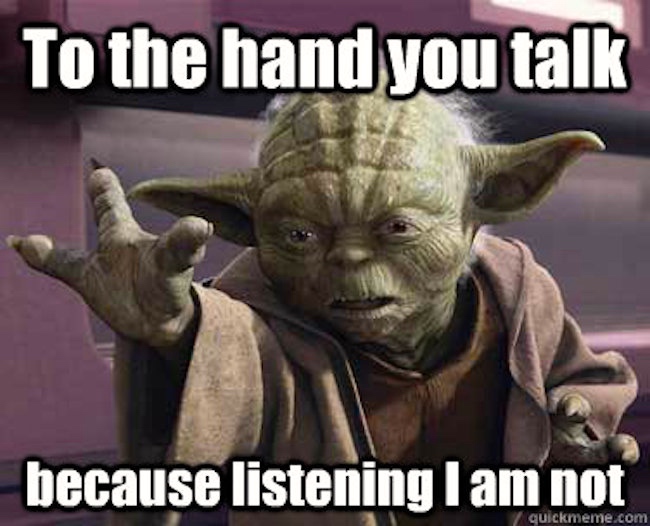
David was not interested in the negative things others might say about him. While his refusal to listen was not as provocative as the ‘90s “talk to the hand” statement, he was focused like a racehorse with blinders on to keep from being distracted. It helps to remember that he was not in denial of his faults, for this is a psalm filled with some powerfully self-aware confession, but he chose to turn down the volume of other voices, to cry out in faith, and to wait expectantly for the very-present Lord to answer and deliver!

So, amid our own seasons of pain and suffering—physical, or emotional/spiritual—to whom do we listen? Whom will we trust to plead our case and deliver us? The psalmist knew the answer and clung to it with tenacious faith.

Desperately Seeking Salvation
The third theme in Psalm 38 is that of the psalmist’s two-fold trust in the Lord—first, that God would hear his prayer, and second, that the covenant-keeping God would be his salvation! It is a powerful contrast that while friends and family may “stand aloof” and enemies will “stand against”, the Lord stands for us and enables us to stand secure in him. 

Even in pain and overwhelming circumstances, David wrote in honest faith,
I am feeble and crushed;
    I groan because of the tumult of my heart.
O Lord, all my longing is before you;
    my sighing is not hidden from you.
(v. 8-9)

Photo by Ismael Paramo on Unsplash
Despite his intense suffering, he did not groan alone, for God heard and saw all his deepest longings and concerns, even those too deep and agonizing to be articulated!

The Christian life is no guarantee that we will be immune to pain, sickness, and criticism, nor does it instantly deliver us from our own foolishness and failures. What it does is give us constant access to an Advocate (1 John 2:1), a Great Physician (Matt. 9:35; Luke 9:6), and a loving God who will never stand aloof in our time of need (Heb. 13:5-6).

There are times when it seems that no one knows my inner struggles, the burdens I carry, or the complete desperation with which I am forced by circumstances and my own failures to lean on Jesus Christ. Yet, such a crucible of heart and mind is common among those in ministry roles. I am thankful for the testimony of Paul, who like the psalmist, relied on God to deliver no matter how hopeless the cause!

For we do not want you to be unaware, brothers, of the affliction we experienced in Asia. For we were so utterly burdened beyond our strength that we despaired of life itself. Indeed, we felt that we had received the sentence of death. But that was to make us rely not on ourselves but on God who raises the dead. He delivered us from such a deadly peril, and he will deliver us. On him we have set our hope that he will deliver us again. (2 Corinthians 1:8-10)

Friday, April 7, 2017

Psalm 36: What Speaks to Us...Deep in Our Heart?

Psalm 36 is especially appropriate during this Lenten season as we examine our hearts before the Lord as we remember his great work to purify our hearts and deliver us from the death our sins produce. 

This post is excerpted from a longer post previously published on my Our Long View blog entitled, "Where there’s Smoke there’s Fire". This brief reflection on Psalm 36 is merely the first part of a longer teaching found there.

“What’s In Your Heart?” or, “What Speaks to your heart?” (Psalm 36)     
A long-running credit card ad series asked "What's in your wallet?" Our approach to Psalm 36 asks "What's in your heart?" or "What speaks to your heart?" 

Psalm 36 describes the nature of the heart of the wicked. Often commentators summarize this passage in terms of the wicked person’s behavior which is certainly addressed, but it is deeper than that. 

This section (v.1-4) describes their heart and what flows out of it.

Transgression speaks to the wicked  
         deep in his heart;
there is no fear of God  before his eyes.
  For he flatters himself in his own eyes
    that his iniquity cannot be found out and hated.
The words of his mouth are trouble and deceit;
         he has ceased to act wisely and do good.
He plots trouble while on his bed;
         he sets himself in a way that is not good;
         he does not reject evil.
When I read this passage I have to ask the question, “What speaks to me, deep in my heart?” We will do what we want to do; we will serve what we love. It may be God and the people he created in his image, or we may serve only ourselves. The wicked serve themselves to the harm of others. We should not fall into the error of the wicked and imagine that we will get away with our iniquity. God will hold us accountable for what we have done. It is hard to imagine someone who lays in bed at night planning how they might take advantage of others the next day! May we not allow transgression to speak to us deep in our hearts. That place should be reserved for something much better!

In contrast to the wicked, the psalmist allows God’s love to capture his heart in v. 5-9,

Your steadfast love, O Lord, extends to the heavens,
    your faithfulness to the clouds.
Your righteousness is like the mountains of God;
    your judgments are like the great deep;
             man and beast you save, O Lord.
How precious is your steadfast love, O God!
    The children of mankind take refuge in the shadow of your wings.
They feast on the abundance of your house,
    and you give them drink from the river of your delights.
For with you is the fountain of life;
       in your light do we see light
.
He ends this psalm with a heartfelt prayer for God’s love to continue (v. 10), and a prayer to be delivered from the actions of the wicked for they will ultimately be “unable to rise.” (v.11-12). 

So how can we keep the pride of the wicked from our own hearts? 

Proverbs 6 gives us a plain warning…like that of a smoke detector! The rest of this message can be found in, "Where there’s Smoke there’s Fire".


Thursday, April 17, 2014

Psalm 4 "Be Angry and Do Not Sin"

Photo by NeONBRAND on Unsplash
Psalm 4:1-2a, 4
Answer me when I call, O God of my righteousness!
    You have given me relief when I was in distress…
O men, how long shall my honor be turned into shame?
...Be angry, and do not sin;
    ponder in your own hearts on your beds, and be silent. Selah

Comments:
This psalm begins with a cry to God for an answer, quickly followed by the acknowledgment that God has been faithful to provide relief in the psalmist’s distress in the past. I find that in my most angst-filled moments it is helpful to stop and remember God’s great track record in the past. This practice is very settling, even when people are saying things that aren’t true about you or tarnishing your reputation. Remembering God’s faithfulness to me is always a great remedy for the offenses of people.

The psalmist’s advice in v. 4 “Be angry, and do not sin” is not an unhealthy repression of the very real problem, but a command to do four very positive things. In the anger that rises up in the face of unjust treatment (by words and/or deeds),
  1. Don’t sin. In other words, don’t make things worse by taking things into your own hands and stooping to their level.
  2. Don’t speak out of your anger. I know from experience that it is too easy to return fire verbally and yet too hard to try to put out the fire that is started by our “righteous” response. I have to regularly remind myself that my wrath doesn't result in God’s righteousness. (James 1:19-20)
  3. Ponder it in your heart on your beds. It is natural to replay the situation, but the wisdom here is that it is processed privately rather than publicly. It is not a rallying of public support but a personal act of trust in God. As I have said many times, Psalms allow us to process our emotions through the character of God. As a result, we are changed and enabled to do the fourth thing...
  4. Offer the right sacrifices. Right sacrifices are not an outward performance of ritual or duty, but a sincere act of repentance, thankfulness, and trust. Will I choose to do this in the haboob of my offense? Right sacrifices can only be offered once I realize my need for the mercy of God.
Interestingly, v.4  is quoted in the New Testament in Ephesians 4:26…where it is emphasized that you should not carry your wrath over to the next day. As followers of Jesus, we are not storing these offenses away and planning our sweet revenge! Instead, we need to promptly process our emotions through God’s faithfulness and the mercy and grace that we ourselves have received. Don't let anger ferment into bitterness and hatred. Bring it all to the One who understands us and defends us. 

People may speak lies and slander us, minimizing our usefulness and value in the kingdom, but God is the one whose opinion counts. It is God himself who chooses us—setting us aside to play on his team! What an honor!

Saturday, August 31, 2013

Psalm 143 "Sitting in Darkness"

Psalm for Today = 143:1-4
1 Hear my prayer, O Lord;
    give ear to my pleas for mercy!
    In your faithfulness answer me, in your righteousness!
2 
Enter not into judgment with your servant,
    for no one living is righteous before you.

3 For the enemy has pursued my soul;
    he has crushed my life to the ground;
    he has made me sit in darkness like those long dead. 
4 Therefore my spirit faints within me;
    my heart within me is appalled.

Comments:
This psalm of David is classified as an Individual Lament; individual because it is written in the 1st person singular (me, my, I) and a lament, not because it is sad or mourning, but because it is asking God for something. There was a situation in the life of the psalmist that needed the intervention of the Lord.

What impressed me this morning as I was reading was not David’s request for help but his confession that “no one living is righteous before you”(v.2). As Christians, we are quick to quote Romans 3:23’s “for all have sinned” and move on. Yet I wonder if we really believe that we are sinners who stand no chance of talking, explaining, or bluffing our way into eternity. Surely if God were to judge between us and our enemies, we would be justified — right? No, we are all unable to stand should God enter into judgment with us…no matter our nation, race, culture, or socio-economic class. We are no better than any other in this respect.

1 John 1:8-9 says, “If we say we have no sin, we deceive ourselves, and the truth is not in us. If we confess our sins, he is faithful and just to forgive us our sins and to cleanse us from all unrighteousness.”

David understood confession. He also understood how his enemies had impacted his life. In poetic language, he describes the darkness in which he was forced to live. How Jesus changes this! While our physical circumstances may not be changed immediately, Jesus came to minister to those in darkness. As we see in the Gospels,

Matthew 4:15-17 [Isaiah 9:1-2]
15 “The land of Zebulun and the land of Naphtali,
    the way of the sea, beyond the Jordan, Galilee of the Gentiles—
16 the people dwelling in darkness
    have seen a great light,
and for those dwelling in the region and shadow of death,
    on them a light has dawned.”
    the way of the sea, beyond the Jordan, Galilee of the Gentiles—
16 the people dwelling in darkness
    have seen a great light,
and for those dwelling in the region and shadow of death,
    on them a light has dawned.”
17 From that time Jesus began to preach, saying, “Repent, for the kingdom of heaven is at hand.”

John 1:9-13 
“The true light, which gives light to everyone, was coming into the world. 10 He was in the world, and the world was made through him, yet the world did not know him. 11 He came to his own, and his own people did not receive him. 12 But to all who did receive him, who believed in his name, he gave the right to become children of God, 13 who were born, not of blood nor of the will of the flesh nor of the will of man, but of God. 

Are we a zombie nation, or does our heart condition appall us? Will we confess our need to the Lord? Will we admit our guilt and unworthiness? Will we receive the true light, Jesus Christ’s gift of salvation, or will we sullenly choose to continue sitting “in darkness like those long dead”?

We all need to hear and heed the words of Jesus,
       “Repent, for the kingdom of heaven is at hand.”