Showing posts with label Persecution. Show all posts

Tuesday, August 27, 2024

Psalm 54 David's Data Breach in Ziph

Photo by Arif Riyanto on Unsplash
After the epigraph, which helps to set the specific context of this psalm, this short, seven-verse psalm gets right after it. There is no gradual build-up, no extended metaphors or subtle poetry. David had a problem and was quite direct in his prayer to the only one who could save him.

The initial epigram reminds us that the Ziphites took David’s personal information and sold it on the dark web to the bad actor, King Saul. They did it twice! The first time was recorded in 1 Samuel 23.

Then the Ziphites went up to Saul at Gibeah, saying, “Is not David hiding among us in the strongholds at Horesh, on the hill of Hachilah, which is south of Jeshimon? Now come down, O king, according to all your heart's desire to come down, and our part shall be to surrender him into the king's hand.” (1 Sam. 23:19-20)

A Ziph-like shot of the Judean Mts. Photo: Greg K. Dueker2011
King Saul commended them for this breach and asked them to keep spying on David (v.22-24). This information dump allowed Saul to hotly pursue David ‘round the mountain until reports of a Philistine raid arrived and Saul had to break off the chase. David named that place seh'-lah hammakh-lek-oth' or “The rock of escape.”

Later, in 1 Samuel 26, the Ziphites informed Saul about David again.

Then the Ziphites came to Saul at Gibeah, saying, “Is not David hiding himself on the hill of Hachilah, which is on the east of Jeshimon?” So Saul arose and went down to the wilderness of Ziph with three thousand chosen men of Israel to seek David in the wilderness of Ziph. And Saul encamped on the hill of Hachilah, which is beside the road on the east of Jeshimon. But David remained in the wilderness. (1 Sam. 26:1-3)

The Ziphites, by their treachery, violated the universal law of hospitality they should have kept toward the anointed one who lived in their midst. Understandably, David felt utterly betrayed, yet his focus was on the help of the Lord being better than the help of humanity.

From the beginning of this psalm, he mentions “your name” in parallel with “your might” as the answer to his cry for salvation and longing to be heard.

Photo by Matheus Ferrero on Unsplash
If God doesn’t do anything in answer to our prayers, then why would David pray so fervently that God would hear his prayer? He prayed that God would “hear” his prayer and give ear to his words because he fully believed that when God hears us, he acts as is natural for him to act—by saving his people, sharing his goodness, and bringing justice down upon the wicked! As I was thinking about the parallel structure of David’s request in v.2, Hear my prayer/ give ear to the words of my mouth” it caused me to wonder how much of what we say is prayer and even how much of what we say do we want the Lord to hear? Ouch! Instead of ignoring God in my speech, what if “all the words of my mouth” were a prayer?

In v.3 the psalmist refers to “strangers/ ruthless men” … not so much foreign adversaries but those in Israel who did not practice the protective hospitality of God. Instead, they seek to kill the supplicant, which in this case was the young pre-king David. Why would they be so unneighborly? I would say it was the natural result of their selfishness… “They do not set God before themselves.”

Photo by Maƫl BALLAND on Unsplash
Will we struggle alone trusting our own strength and wisdom to contend for our rights, the respect we feel we deserve, and even a good return on our retirement accounts? Or will we like David trust God to be our “helper/upholder” (v.4)?

Behold, God is my helper;
    the Lord is the upholder of my life.

Being a helper is not just women’s work (as some misinterpret Gen 2:18,20) it is the faithful work of God! We need more warrior-helpers today! We can all appreciate those who encourage us in our difficulties with their words and actions. What if we, as the body of Christ, were more concerned about upholding others than knocking them down?

Some people are evil and thus unjust. Some show themselves to be our enemies, but it is not our job to destroy them, God will bring their wicked plans back upon them. Their evil intentions will come back to bite them... hard! This is less a Davidic imprecation than a statement of fact about how God works in the lives of his people.

He will return the evil to my enemies;
    in your faithfulness put an end to them. (v.5)

I am reminded of a verse in Proverbs that says,Like a sparrow in its flitting, like a swallow in its flying, a curse that is causeless does not alight.” (Prov. 26:2) In their case there is cause in abundance!

The psalmist confidently declares that he will worship the Lord in an overflow of gratitude for deliverance… even though the deliverance has not happened yet. Let us not miss the “freewill offering” aspect of v. 6. The psalmist sees such sacrificial giving as joyful worship, not a begrudgingly compliant obligation.

With a freewill offering I will sacrifice to you;
    I will give thanks to your name, O Lord, for it is good. (v.6)

If we wait for everything to be perfect before we worship with our giving, it will likely never happen. There will always be one more problem to face, one more crisis to conquer, one more debt to pay, one more day to wait. The blessing available to us is that we can enter into victorious living even amid hardship if we choose a life of generous gratitude! We can enter the joy of the Lord right now! To this point, Paul commended the glad generosity of the Philippian church in Macedonia who gave despite severe circumstances.

We want you to know, brothers, about the grace of God that has been given among the churches of Macedonia, for in a severe test of affliction, their abundance of joy and their extreme poverty have overflowed in a wealth of generosity on their part. For they gave according to their means, as I can testify, and beyond their means, of their own accord… (2 Cor. 8:1-3)

In concluding my comments on this psalm, I would say that once we confess, pray, put our trust in the Lord, gratefully worship, and by faith see the future victory we should not forget our testimony. We should be bold in telling the good things that God has done for us. Even if today’s issue has not yet been resolved in our experience, we can testify to how God has delivered us in the past.

For he has delivered me from every trouble,
    and my eye has looked in triumph on my enemies. (v.7)

What the enemy intends for evil, God in his amazing love can coopt and use for good. Waiting is hardly ever enjoyable, but trusting the Lord can smuggle contentment into almost any difficulty... even this election season. 

Photo by JESHOOTS.COM on Unsplash
How will we prepare for the coming week? 

Will we proactively ask for God’s help? 

Will we talk to the Lord about all that is happening in our lives? 

Will we respond to the challenges we face this week by committing them to the Lord’s justice and mercy? 

I hope so.


Saturday, January 21, 2017

21 Days of Prayer in Psalm 119 (Day #21)

Read Psalm 119:161-168

“Spoil”

On this last day of our 21 Days of Prayer + fasting, I ask the question why we are finishing one section short of the end of the Psalm? Perhaps we will finish this tomorrow in church!

Despite our country being in the midst of a time of political division, despite destructive protesters, I do not personally feel persecuted. However, in some contexts that feeling would change, depending on who surrounded me. However, in many countries, Christians have been able to say this first line from verse 161 with the psalmist,

Princes persecute me without cause,
    but my heart stands in awe of your words.
I rejoice at your word
    like one who finds great spoil.
Many times “princes” have felt threatened by humble Christians, simply because a Christian’s highest loyalty is not to the state but to the Kingdom of God in Christ. Christians should pose no violent threat to any if they are following the way of Jesus.

However glorious the pageantry of princes, what is most awesome to followers of Christ is what he has said to us in his word. Join me in standing in awe of what he has proclaimed and brought to pass—that we who were once afar off “have been brought near by the blood of Christ. For he himself is our peace, who has made us both one and has broken down in his flesh the dividing wall of hostility  (Eph 2:13-14)

Such words of promise fulfilled should cause us to rejoice (v. 162) like one who has found much treasure. I remember when I was a child, we would play in the forest behind our house as though we were hunting for lost pirate treasure. Almost anything seemed to be a clue to finding the treasure—but we never did. However, such imaginary adventures give insight into both the longing for and the joy of discovery such a find might bring. Do we have the same response to God’s word? Have we found that our significance, identity, and purpose are wrapped up in the love of God pour out for us? That is a treasure indeed—there is nothing in the world more precious and beautiful!

In Matthew 13:44-46, Jesus described the Kingdom of God in just such treasure-finding terms,
“The kingdom of heaven is like treasure hidden in a field, which a man found and covered up. Then in his joy he goes and sells all that he has and buys that field.
“Again, the kingdom of heaven is like a merchant in search of fine pearls, who, on finding one pearl of great value, went and sold all that he had and bought it.
Our heart needs to be captured by the love of Christ, For where your treasure is, there your heart will be also.” (Matt. 6:21) We should not be spoiled by the world's hatred, nor by its riches, but willing to lose/sell it all for the joy of belonging to Christ Jesus! Unlike those who find worldly treasure and become paranoid over hiding and protecting it, when we love God's word we have great peace that we are willing to share (Psalm 119:165).

O Lord Christ, you offer us mercy and the goodness of your grace. We are in awe of your love and faithfulness, all the more vivid when compared to the flawed and failing governments of this world. Let us not live our lives cowering and controlled by fear of governments or hostile crowds. Lord comfort and protect those who are oppressed and persecuted. Let us not be apathetic, but instead, we ask for a Spirit-empowered boldness to stand on your Word, to show love for your ways, and to seek the lost as you sought us. Lord, please speak to us today, and fill us with joy in your presence no matter what comes to pass! Amen.

Wednesday, January 11, 2017

21 Days of Prayer in Psalm 119 (Day #11)

Read Psalm 119:81-88

     “Longing”

For what do we long? The things of heaven or the things of earth? In today’s stanza, we see an increased longing on the part of the psalmist for God to deliver him, to save him, from those who were actively persecuting him (mentioned 4-5 times). This longing is seen in the first two verses,
“My soul longs for your salvation;
              I hope in your word.
My eyes long for your promise;
             I ask, “When will you comfort me?”
(v. 81-82)

Trusting God is no guarantee that you will get whatever you want right now. If fact it is often quite the opposite. However, he is with us right now in the midst of any trials we are facing. It is in the tough times that we can learn from the psalmist’s testimony. When facing persecution, he does not turn from the Word of God but hopes in it and keeps it all the more faithfully. May we have the same resolve when we are pressed.

This passage causes me to look ahead to Revelation 12:10-11 where John describes the great age-long battle between the dragon and the people of God.
"And I heard a loud voice in heaven, saying, “Now the salvation and the power and the
kingdom of our God and the authority of his Christ have come, for the accuser of our brothers
 has been thrown down, who accuses them day and night before our God. And they have conquered him by the blood of the Lamb and by the word of their testimony, for they loved not their lives even unto death."


My fear is that our deep longing is not tied to our love for Christ and his Word but has become more focused on the earthly things that make for a comfortable life. I hope we would be able to stand “not loving our own lives even unto death” but I have my doubts.

O Lord, you know the desperate requests of your people around the world, the things they need to stay alive and to stand firm. I pray that you would fulfill their sacred longings even now. Please save, even those who don’t yet realize that they need to be saved. Please comfort the bullied, vindicate the persecuted, and embolden the harassed. Bring truth and justice to light along with the mercy available to us through the promises of your Word fulfilled in Christ! Enable us to stand in faith because you stood for us. Amen.

Monday, August 18, 2014

Psalm 17—Hear a Just Cause!

Psalm 17:1, 6-11, 13-15
Hear a just cause, O Lord; attend to my cry!...
I call upon you, for you will answer me, O God;
    incline your ear to me; hear my words.
Wondrously show your steadfast love,
    O Savior of those who seek refuge
    from their adversaries at your right hand.
Keep me as the apple of your eye;
    hide me in the shadow of your wings,
from the wicked who do me violence,
    my deadly enemies who surround me.
10 They close their hearts to pity;
    with their mouths they speak arrogantly.
11 They have now surrounded our steps;
    they set their eyes to cast us to the ground...
13 Arise, O Lord! Confront him, subdue him!
    Deliver my soul from the wicked by your sword,
14 from men by your hand, O Lord,
    from men of the world whose portion is in this life...
15 As for me, I shall behold your face in righteousness;     when I awake, I shall be satisfied with your likeness.
 
Comments:
These are difficult days for those who would remain faithful in the face of brutal persecution, as they were at different times in the past. David spent years fleeing from Saul’s unjust campaign to kill him out of jealousy. The early church faced dreadful persecution at the hands of the Roman Empire. 20th Century Christians suffered and died by the millions at the hands of Communist and totalitarian regimes.
 
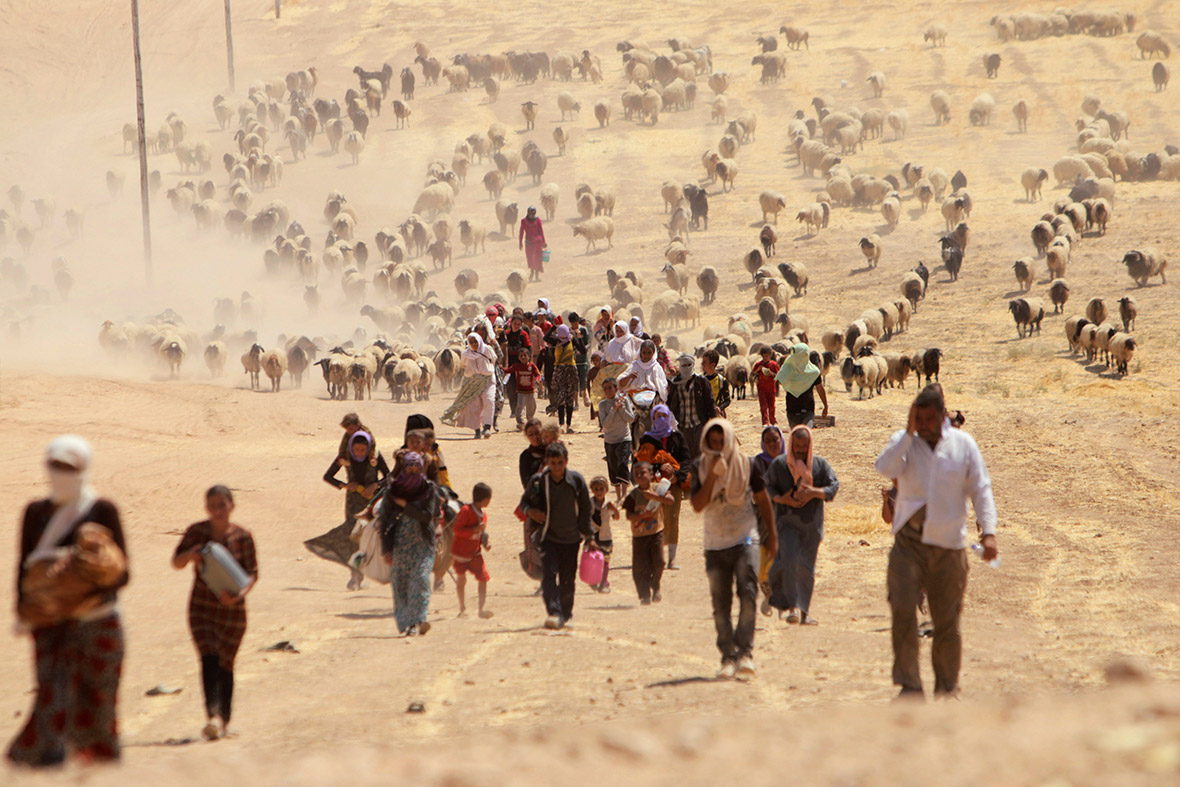
Today, the sword again comes against God’s people from a murderous group of Sunni radicals called ISIS. I wonder if they get the irony of the name they have chosen, that of an ancient Egyptian goddess of magic, healing, and motherhood. While they brutally torture and kill any that will not convert to Islam, and within Islam any that stand in their way. For Christians, they mark their houses with the Arabic letter that is the first in the word for Christians, reminiscent of the Nazi treatment of the Jews in the Holocaust.
 
David's response is instructive for me. In the face of great injustice, he cries out in faith to the Lord for help. He actually believed that the Lord would answer, deliver and save. His language (v. 8 “the apple of your eye” and “the shadow of your wings) deliberately looked back to the great national deliverance from Egyptian slavery as sung about by Moses in Deuteronomy 32:10-12
10 “He found him in a desert land,
    and in the howling waste of the wilderness;
he encircled him, he cared for him,
    he kept him as the apple of his eye.
11 Like an eagle that stirs up its nest,
    that flutters over its young,
spreading out its wings, catching them,
    bearing them on its pinions,
12 the Lord alone guided him,
    no foreign god was with him.
 
He not only remembered the past faithfulness of God, in the midst of the acute situation in which he found himself, but he connected with the larger community of God’s people down through history. I love the way the late Peter C. Craigie captures this idea.
That which makes hope, and therefore confidence, possible is an awareness of the nature of the covenant God. The psalmist was not the first to be in trouble, nor would he be the last, but he believed in a God of covenant, whose most fundamental characteristic was lovingkindness (v.7)…
Though the psalm is written in the language of individuality, it does not contain the words of a lonely and bold pioneer of crisis; it contains rather the words of one sharing in the past and present experience of a community that has known God as a deliverer. The psalmist thus draws upon the strengths of both history and community in reaching his confidence. (Psalms 1-50, p.165)
 
Yazidis fleeing ISIS in Iraq
Out of David’s covenant-based confidence, there is yet a very human urging, even a deeply pleading tone for the Lord to confront the enemy. Today, as we are once again made aware of man’s capability to objectify, abuse, and destroy the innocent and the weak, we cry out to the Lord with Davidic fervency for the deliverance of hurting people—be they religious minority Christians, Yazidis, Sunnis, or Kurds in Northern Iraq. In other areas of the world, it may be other minorities that are being tracked down, surrounded, and slaughtered by power-hungry men.
 
Do we cry out with the psalmist, “Arise, O Lord! Confront him, subdue him!” Using strongly military-sounding metaphors of desperation? Or do we close our eyes to the suffering with excuses de jour and/or limit our responses to government-designated expediencies? I was talking with someone recently who thought that the media was only covering the violence in Iraq today because it was targeting Christians. While I disagree with this assessment as much has been said first about the moderate Sunnis, and more recently about the Yazidis (neither of which are Christian) it does force me to assess my own definition of “neighbor.” Do I only get upset when Christians, or Americans, are being victimized, or do I see how God is concerned for all peoples?
 
Whether we take v. 15 to refer solely to the immediate physical deliverance sought today that enables us to actually wake up tomorrow, or as containing assurance that reaches beyond this life into eternity in the presence of God we should see that the prayer first uttered in v. 1 will be answered in v. 15, one way or the other.
 
In times of trouble, injustice, and persecution we pray for deliverance the like of which is recorded in Hebrews 11:32-35.
And what more shall I say? For time would fail me to tell of Gideon, Barak, Samson, Jephthah, of David and Samuel and the prophets—who through faith conquered kingdoms, enforced justice, obtained promises, stopped the mouths of lions, quenched the power of fire, escaped the edge of the sword, were made strong out of weakness, became mighty in war, put foreign armies to flight. Women received back their dead by resurrection. Some were tortured, refusing to accept release, so that they might rise again to a better life.
 
Every day there are plenty of testimonies of God’s power to miraculously deliver, heal, and restore all over the world today. But it is not always the case that his followers are spared torture and death. The very same text (v. 36-38) goes on to say,
Others suffered mocking and flogging, and even chains and imprisonment. They were stoned, they were sawn in two, they were killed with the sword. They went about in skins of sheep and goats, destitute, afflicted, mistreated— of whom the world was not worthy—wandering about in deserts and mountains, and in dens and caves of the earth.
 
Are we willing to follow Christ if the deliverance doesn’t come today the way we desire? The last book in the Bible encourages followers of Christ to “overcome” the urge to save our own lives by compromising with the idolatries of the world. Those who overcome do so “by the blood of the Lamb and by the word of their testimony, for they loved not their lives even unto death.” (Rev. 12:11)
 
If our portion is merely in this life we will close our hearts to pity (v.10) and abuse others in order to expand and prolong it. However, if we trust that our portion is ultimately in the presence of a God who is wondrous in showing his steadfast love (v.7) we will seek to care for the oppressed wherever we find them.
 
I am moved by the story of the Danes, who when the Nazis ordered Danish Jews arrested in 1943, stopped what they were doing and did whatever they could to hide Jews and ferry them to safety in Sweden. What can we do for the powerless today?


Saturday, July 20, 2013

Psalm 109 I give myself to prayer...with a vengence?

Photo by Jon Tyson on Unsplash
Psalm for Today = 109:3-5

They encircle me with words of hate,
    and attack me without cause.
In return for my love they accuse me,
    but I give myself to prayer.
So they reward me evil for good,
    and hatred for my love. (v.3-5)

Comments:
In this lament, David asked God for deliverance from the wicked men who pursued him verbally and physically. They were evil men in every sense of the word. But how did David respond to such injustice? He gave himself to prayer. I wish I was so consistently spiritual when faced with rejection, slander, and hate.

David also gave himself to prayer in a way that Christians usually don’t. It is called “imprecatory prayer” and is like praying judgment or a justly-deserved curse down on the wicked. I read “They encircle me with words of hate” in verse 3 and am struck with the word picture. It seems that David’s prayer encircles their words of hate with his words of trust that God will deal with them righteously…though they are not kind words. Verses 6-20 ask God to deal with these specific oppressors in very specific ways appropriate to their sins (esp. v.17).

As followers of Christ, we are to pray for those who curse us. Like the psalmist, we can process our emotions honestly through the character of God and his commitment to justice. We can also pray and ask God, like the martyred souls in heaven when will He avenge all the innocent blood that has been shed by the wicked (Revelation 6:10)? But like Jesus prayed on the cross we should also pray for their forgiveness “for they don’t know what they do” (Luke 23:34).

Ultimately, all judgment is in God’s hands and he will make it all right!